Kā Pakihi Whakatekateka o Waitaha
The vast network of wetlands and plains of Kā Pakihi Whakatekateka o Waitaha/Canterbury Plains is inherently important to the history of its early occupation. The area was rich in food from the forest and waterways. Major awa (river) such as the Rakahuri (Ashley), Waimakariri, Pūharakekenui (Styx) and Rakaia were supplied from the mountain fed aquifers of Kā Tiritiri o te Moana (Southern Alps). The rivers teemed with tuna, kōkopu, kanakana and īnanga; the wetlands were a good supply of wading birds and fibres for weaving, food and medicine; with the forest supplying kererū, kokopa, tūī and other fauna as well as building materials. In 1879 at Kaiapoi, Wiremu Te Uki, stood before the Smith-Nairn Commission and declared: ‘We used to get food from all over our Island; it was all mahinga kai. And we considered our island as in a far superior position to any other, because it is called Waipounamu, the greenstone island; the fame thereof reaches all lands’. Ara tawhito (travelling routes) crossed over the landscape providing annual and seasonal pathways up and down and across the plains and in some cases skirting or traversing the swamps. Permanent pā sites and temporary kainga were located within and around the Plains as Waitaha, Ngāti Māmoe and Ngāi Tahu settled into their occupation. They were present for hundreds of years before the arrival of new settlers and associated controversial land sale.
For immigrants arriving in the mid-nineteenth century, Māori presence in the area that developed into colonial Christchurch was not high. The closest Ngāi Tahu reserves were at Tuahiwi to the north and Rāpaki to the south in Banks Peninsula. The area that became the suburb of Addington, south-west of the central city, is close to historic Māori trail systems. In its natural state, the area was a mosaic of tussock, flax, tutu, toe toe and fern, and had two small water courses. Jackson Creek rose west of Addington and originally flowed freely as a clear stream through its southern parts into the Heathcote River well east of Addington. Another shorter creek drained a swamp and flowed across South Hagley Park to join the Avon River near what is now the Christchurch Hospital – this creek became the lower reaches of the Addington Drain.
From the late 1840s, a programme of systematic colonial settlement was established by the Canterbury Association, led by John Robert Godley and Edward Gibbon Wakefield. Founded on the principles of the Church of England, the Canterbury Colony’s chief city was to be Christchurch. From 1849-1850 the Canterbury Association surveyed the town of Christchurch, with an Anglican Cathedral to be built at the physical heart, and rural sections outside of the town boundary. The ‘First Four Ships’ carrying the first Canterbury Association settlers arrived in Lyttelton in December 1850. One of the new arrivals, John Williams, died on the Bridle Path while walking from Lyttelton to Christchurch, only a few days after arriving in the new colony. He was the first to be buried in Lyttelton’s Anglican cemetery, in December 1850.
Early cemeteries and burial grounds in Christchurch
Māori burial grounds are urupā. In Ōtautahi/Christchurch, individual interment is known to have been carried out but it is not clear if there were urupā as such. The early colonial cemeteries in Christchurch adhered to both old and new burial ground ‘traditions’ of Britain. Some were buried in churchyards outside the central city boundaries, such as at Holy Trinity Church in Avonside (established in 1855), following the older British tradition. No central city churchyards were used for burials because that need was met by a Church of England cemetery established on Barbadoes Street, in the north-east corner of the city, in 1851.
This followed the newer tradition where large public cemeteries were created that were not physically associated with a church building. The Barbadoes Street cemetery was divided into three separate sections: Anglican (Church of England), Roman Catholics, and all other religious groups in a section called ‘Dissenters’. There was no special provision for a burial ground for Presbyterians so they had to be interred in the ‘Dissenters’ section of the cemetery. It was this issue (and the fact that once the cemetery had been consecrated by Bishop Harper, burials could not be performed by any other than a minister of the Anglican Church) that led to the Presbyterians seeking to establish a cemetery of their own.
In 1858, the congregation of St Andrew’s Presbyterian Church acquired five acres of land on Selwyn Street, Addington, for a public burial ground, which allowed for the performance of any religious service at the burial (so long as it was in good order and not contrary to public decency). The land was part of Rural Section 66, a block of originally 50 acres that had been purchased from the Canterbury Association by Mrs Ann Margaret Buchanan of Sussex, England and she had transferred the land to her son John Buchanan in 1855.
The cemetery was vested in five trustees – Reverend Charles Fraser, the first minister of St Andrews, and Messrs G. D. Lockhart, W. B. Bray, William Wilson, who later became Christchurch’s first mayor in 1868, and J. Anderson, founder of Andersons’ foundry. In its early years it was known as the ‘Christchurch Public Cemetery’ and the ‘Scotch Cemetery’.
The cemetery was laid out and planted by the Deacons’ Court of St Andrews, which remained involved in administration even after a cemetery trust was formed in 1861. The laying out of the grounds, including ditch and fencing, drainpipes and planting was undertaken relatively quickly and continued through the 1860s and 1870s. Early planting at this time included gorse hedging, macrocarpa trees and Darwinia shrubs. Planting in and near graves appears to have been at the discretion of those who paid for the plots.
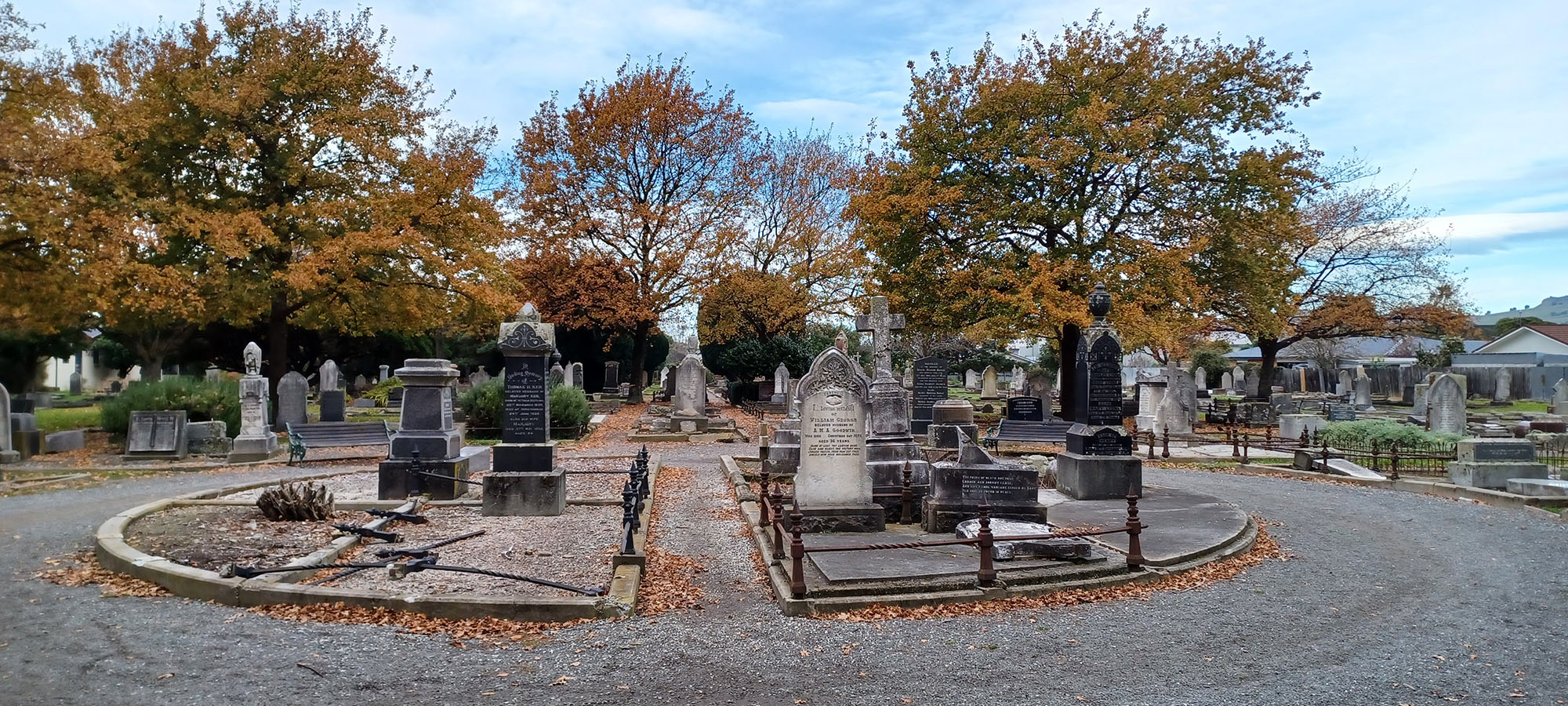
The initial layout allowed for a wide path from the Selwyn Street entrance leading to a central turning circle and then a similarly wide path extended from the turning circle to the east end of the cemetery. As more burial space was required, the eastern path was used instead for burial plots. The same occurred around the outside of the turning circle and many of the early plantings and pathways on the periphery of the cemetery were removed to create extra space at the extreme boundaries.
From the outset, selling the plots was a deliberate money-making venture to raise funds for St Andrews; the tight spacing of the plots enabling more funds to be generated than had they been more spacious. Records for the cemetery detail payments for plots, interments and reinterments, along with various payments for ‘dressing’ (sometimes cleaning) the graves.
Differences of opinion within the Presbyterian church owners of the cemetery around its financial management and administration drew to a head in the early 1880s. There was a suggestion that improper management of payments received for plots resulted in some sections in the ‘Scotch Cemetery’ being sold as many as three and four times over to different parties. The matter appears to have been resolved by 1886, with the Deacons’ Court taking over management, but the issue of squeeze for burial plots remained. By 1888 all the plots were sold and the cemetery was considered ‘full’. From the late nineteenth century and into the twentieth century, even many of the family plots were already full up. Small bits of new burial land were identified, for example ‘next to sheds’ but space was tight.
While poor record-keeping of payments had caused consternation, there are nevertheless good records relating to the name and age of people interred in particular plots, reinterments and aspects of general maintenance at the cemetery. The earliest records, in the late 1850s and early 1860s, also often indicate a cause of death – ‘found drowned’, ‘consumption’, ‘hooping cough’, ‘scarlet fever’, ‘dropsy’ and so on – though such details rarely carry through onto a headstone. An exception is where someone has died at war, as many an individual headstone or family monument records this context. Cemetery records from the earliest years through to the early decades of the twentieth century show very many stillborn and young children buried at this cemetery. Some of those may not have had formal plots, as a number of the interment records state that stillborns and premature babies are given a ‘spare piece of ground’ and/or ‘next fence’. However, many family memorials do include the names of infants and young children.
Most of those buried at Addington are either nineteenth century migrants from Scotland, England and Ireland or their direct descendants. Fewer are identified as coming from other places in Europe. A small number of Chinese migrants were interred in the cemetery, notably Yum Gee, who died in 1888, and Dok Kee, who was buried in 1889 by the minister of the Addington United Free Methodist Church, with a large number of Chinese countrymen present. It is not clear if there are any Māori buried at the cemetery. Whether explicitly or implicitly, many of those buried in the cemetery were nonconformist - that is, not belonging to the established Church of England - in their religious beliefs.
Early leaders from many different churches are buried at this cemetery. They include:
Rev. Charles Fraser who had emigrated from Scotland in 1856 to lead the new congregation at St Andrew’s Presbyterian Church. Not only did he secure land for this cemetery, he helped establish the Canterbury Museum, Canterbury College (now the university) and the Christchurch Academy (now Hagley College).
Rev. Thomas Fisher who was a Wesleyan Methodist minister and shopkeeper.
Rev. James Fergusson, Presbyterian minister whose efforts lead to the construction of St John’s Church in Lyttelton.
Rev. Samuel MacFarlane who was a United Methodist Free Church minister.
Rev. Dr John Elmslie was the founding minister of St Paul’s Presbyterian Church in Cashel Street which later became St Paul’s Trinity Pacific Church.
Rev. David McKee was the founding minister of North Belt Presbyterian Church (later called Knox Church) on Bealey Avenue.
Rev. William Pole was the first pastor of Spreydon Baptist Church (now South West Baptist Church)
Numerous individuals and families of interest have connections to this cemetery. Notables include:
John Anderson (Row G, No. 879) of leading Christchurch iron foundry and engineering firm who is associated with some of New Zealand’s most significant early bridges and viaducts, was also mayor of Christchurch (1869) and was also closely involved with the Presbyterian church and the establishment and management of this cemetery. Scottish-born, he had arrived in Christchurch in 1850 as part of the Canterbury Association programme of settlement. When he died in 1897, newspapers described the cortège leaving for ‘the Presbyterian Cemetery at Addington’ as follows: ‘The late Mr Anderson’s carriage, filled with wreaths, followed the hearse, and next came the carriages containing relatives of the deceased. … The procession was about a mile long, and in addition to the 200 present and past employés of the Canterbury Foundry, who marched in fours, no fewer than 113 vehicles contributed their quota to the attendance. The streets en route were lined with spectators, and there was a large number of people waiting at the cemetery when the procession arrived there. At the grave the Rev. Dr Elmslie read the funeral service, and the prayers were conducted by the Rev. Gordon Webster. Every branch of commerce, industry and occupation was represented in the large gathering.’
Rebecca and Stephen Brooker (Side Row 3, K-L), early landholders at New Brighton (named after Brooker’s home town, Brighton in England). Rebecca had been a mission nurse in the 1830s. Having learned te reo Māori from her patients, she became an interpreter between the colonial government and Ngāti Whātua when the site for Auckland was purchased.
Campbell family (No. 880) - the family of Dr Campbell, his wife and five children are buried in a single plot – they were all killed when the S.S. Tararua was wrecked off the coast of Southland in 1881. Their memorial was made in Scotland from red granite stone and was shipped to New Zealand in 1882 for erection at the ‘Scotch Cemetery’ in Addington.
Andrew Duncan (Side Row D, No. 1223-1225). Scottish-born Duncan arrived in Canterbury in 1858 worked his way up from farm labourer to mayor of Christchurch (1870). Later, as Canterbury’s emigration agent in London, he used his own success as evidence of opportunities awaiting new settlers in Canterbury.
Deans family (Centre Circle A). John Deans II was the son of very early Canterbury settlers from Scotland, Jane McIlraith Deans and John Deans I, and was born at Riccarton in 1853. When his father died in 1854 (buried in the Barbadoes Street Cemetery), infant John Deans II inherited the early Canterbury farm at Riccarton. He married Catherine Edith Park in 1879 and the couple had 12 children in 16 years. One of their children was Robert (Bob) Deans, well-known as an All Black in the 1905 rugby union team that toured Britain.
Deans family memorial at front on centre circle (R. Burgess, 1 Oct. 2023, Heritage New Zealand Pouhere Taonga)
Samuel Farr (Area 3, Row I), prominent early Canterbury builder-architect who’d arrived in Akaroa in April 1850, along with his fiancé, Mary Ann Pavitt and her other Pavitt family members. Samuel and Mary Ann’s wedding in June 1850 was said to be the first (colonial) marriage in Canterbury. The Pavitts, in partnership with Farr, built one of Banks Peninsula’s early timber mills, at Robinsons Bay.
John Gibb (Side Row E, No. 1280) was an artist known for his landscapes and maritime scenes. Gibb was one of the first professional artists to settle in Christchurch. Shortly after arriving in 1876, he became a central figure in the city’s fledgling arts circle and a foundation member of the Canterbury Society of Arts. He travelled throughout the country, sketching and making notes that he later used to complete his large landscape paintings.
Ebenezer Hay (No. 817) Hailing from Scotland, Hay and his large family emigrated to Wellington in the 1840s and he’d helped other Scots obtain a passage on New Zealand Company ships. He came from Wellington to Canterbury, setting up a farm at Pigeon Bay in 1843. When he died from an accident on the Bridle Path in 1863, an inquest was held and his funeral notice requested friends attend the funeral ‘from Parker’s Hotel to Christchurch Cemetery’. Ebenezer Hay’s funeral was reported as being numerously attended. His wife was buried in the same plot in 1880.
George McIlraith (Block O, Plot 52), was the first burial at the cemetery. He was Jane Deans’ brother and had died on 26 November 1858 age 20 from a riding accident at the Deans’ property at Homebush.
John and Allan McLean (Row P, No. 291), early Canterbury runholding brothers who became some of Canterbury’s largest landowners and wealthiest men. Allan McLean’s Christchurch home, Holly Lea (McLean’s Mansion), was New Zealand’s largest timber residence and when he died in 1907, it was left in his will to be used ‘as a home for women of refinement or education in reduced or straitened circumstances’. A tall obelisk marking the brothers’ graves partly toppled in the Canterbury Earthquakes of 2010 and 2011.
Wilhelm Kissel – came to Christchurch as a Canterbury Association settler and opened the first saddler’s shop in Christchurch. A native of Bavaria and one of the first German settlers, he subsequently welcomed many of his countrymen when they arrived in Canterbury. He was also one of the promoters of the German church and German Liedertafel (men’s choir). Built on the corner of Montreal and Worcester Streets in central Christchurch, the larger timber German Church (Deutsche Kirche) was opened in 1874, its noteworthy bells having been cast in Berlin and brought out to New Zealand. His wife, Magdalena (née Tisch) is also buried with Wilhelm and they share a headstone. Wilhelm’s brother, Heinrich, his wife and daughter are also buried at the cemetery and share a headstone.
Kate Sheppard (Row F, No. 422a), ‘Katherine Wilson Lovell-Smith, formerly K.W. Sheppard’, née Catherine Malcolm, is buried in the Malcolm family plot. Pioneering New Zealand suffragist, Kate Sheppard, is the nationally and internationally celebrated heroine at the helm of a long campaign that met success in 1893, making New Zealand the first country in the world to secure the right for women to vote in national elections. With the headstone showing her second married name, Lovell-Smith (‘formerly Kate Sheppard’), the grave is surrounded by white camellia bushes – symbol of the suffrage movement - that were planted in the 1990s.
Left: Representatives of the Kate Sheppard Women’s Bookshop placing flowers on the grave of Kate Sheppard to mark the 92nd anniversary of women’s suffrage in 1985.
As well as Kate Sheppard, other signatories of the 1893 Suffrage Petition known to be buried in Addington Cemetery include Marie Beath, Emily Wallis, Julia Holmes, Harriet Bird, Helen Ashwin, Catherine Hocking, Barbara Yates, Janet Stewart, Annie Lightbody, Eugenie Tillman, Mary Eliza Bulling, Sarah Billens, Catherine Gledhill and Elizabeth B. Taylor.
Thomas Edward (Tommy) Taylor (Row O No. 1939). T.E. Taylor was a Member of Parliament, an outspoken prohibitionist and socialist, who championed labour reform and for improved conditions in hospitals and asylums. He became mayor of Christchurch in 1911 and died in office that year. Over 2,000 people were involved in a mile long funeral procession, which ‘slowly and in solemn silence wound its way’ to Addington cemetery. Two years later, in June 1913, a Dominion monument on his grave was dedicated to Taylor, with a large gathering at the event at Addington Cemetery. The inscription on the monument reads ‘Sacred to the memory of Thomas Edward Taylor, beloved husband of Elizabeth B. Taylor, born June 16, 1863; died July 27, 1911. Statesman, orator, reformer, prohibition leader, member of Parliament nine years, Mayor of Christchurch 1911.’ Also buried here is Elizabeth Best Taylor (née Ellison) who campaigned for temperance, peace and the rights of women and children (suffrage). She was the first president of the Christchurch Crèche and Kindergarten Association, and a leader in the Women’s Christian Temperance Union.
John Twigger (Row Q, No. 307), a large Addington landowner, was buried in the cemetery in 1885 and his wife was buried alongside him after her death in 1891. Twigger, who was the heir of an Anglican cleric, left his fortune to charity. Beneficiaries included Cholmondeley Children’s Home and, in the late twentieth century, the Home arranged for Twigger’s grave to be restored.
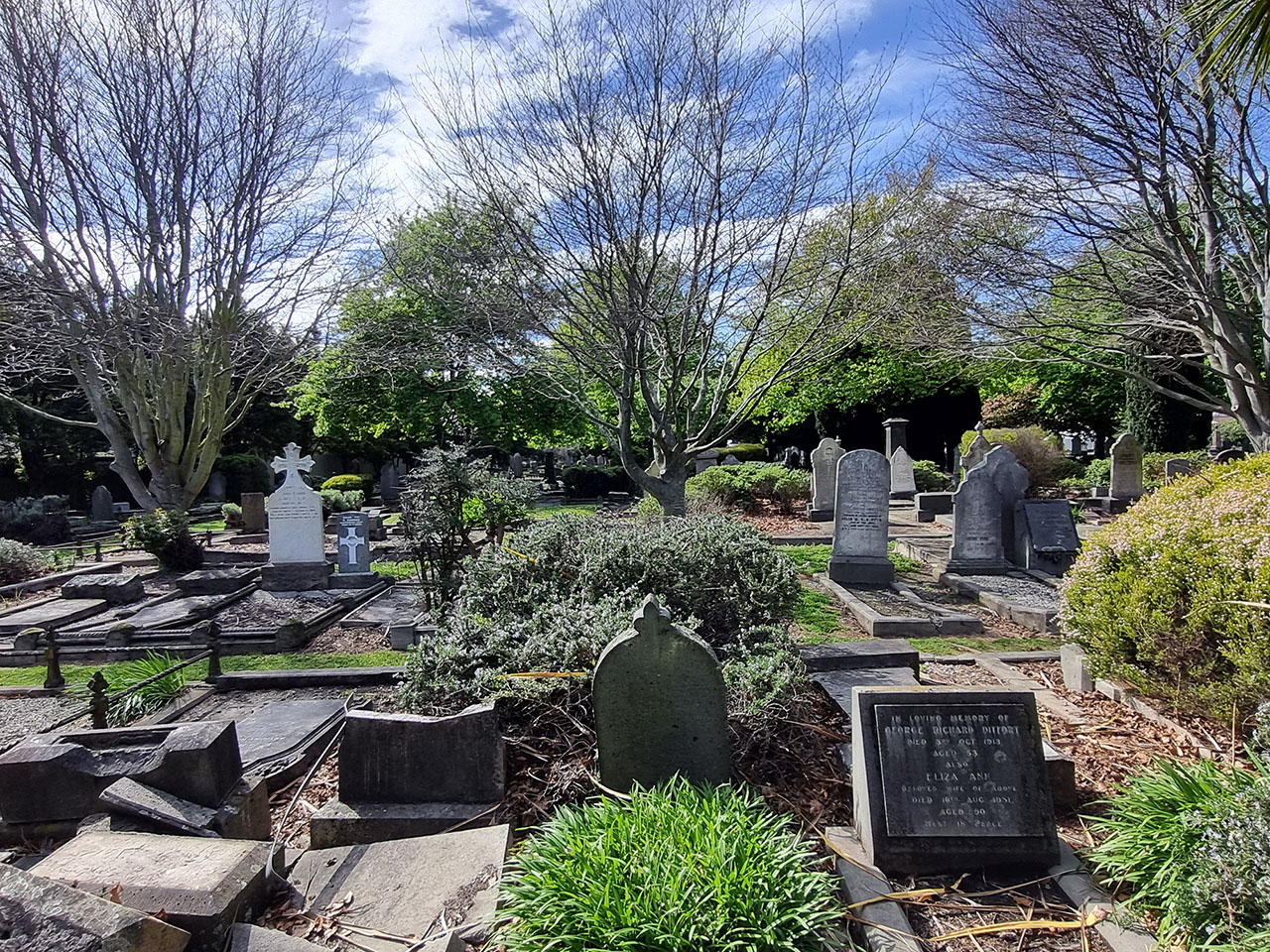
Not all graves are marked and some probably never were. It is possible that some of the ‘green’ spaces of Addington Cemetery, particularly the rear and sides, which are not pathways, were used for paupers’ graves. It was also the likely place where ‘clandestine’ burials, especially of infant children, occurred. The Rev. Charles Fraser noted this as being an issue at Addington Cemetery and was reported to the police. It has been surmised that illicit burials could, in part, be attributed to socio-economic factors of the area, and it is also likely a reflection that people wanted loved ones buried in a cemetery, despite the lack of available plot space.
Occasionally, exhumation of remains has taken place. In 1888 the body of Annie Watson was exhumed by the sexton under a coroner’s warrant to satisfy the police’s needs for a post-mortem. In 1908 a permit was granted to exhume the newly buried remains of Henrietta Malthus so that she could be reburied in the family plot in Dunedin.
The cemetery had a Sexton who was responsible for keeping the cemetery in order, collecting the money for the plots and opening and closing of the graves. James Taylor was a long-standing sexton, having been appointed in 1874 and still in service, with an assistant, in 1906. Peter Wilson is known to have been sexton there for several years until his unfortunate death in 1911. Alexander Miller was the cemetery’s sexton in the mid twentieth century.
In June 1923 a building permit for a Sexton’s office and tool shed for the cemetery was granted to J. Robertson. A 1947 report to the Council noted the presence of a shed and Sexton’s office, in good condition, as well as one small privy for both sexes. Sitting outside the actual land parcel, what appeared to have been the foundations of the shed remained in place in the early 2000s until the neighbouring land parcel to the north was redeveloped in circa 2010.
As well as burials, other work around the cemetery included maintaining or replacing the timber and corrugated iron fencing. In 1889 a ‘dilapidated’ fence on the southern boundary was replaced. By 1947, when discussions began in earnest for the cemetery to come under the control of the Christchurch City Council, there was a two metre high, green-painted corrugated iron fence along the Selwyn Street frontage. In 1989 a low concrete wall and post-and-chain fence was installed along the Selwyn Street frontage, as a replacement of the corrugated fence that had been there for many decades. In the 1990s, two access pathways were created at the rear of the cemetery.
Because the plots were sold early, there was little new funding for general maintenance of the cemetery, apart from individual owners of plots who did pay a fee when they wanted specific maintenance, cleaning, or work for their own particular family plot. By the time Christchurch City Council was considering taking over administration of the cemetery in 1947, it was reported as being very overgrown and vandalised and the Council even considered removing all headstones to turn the cemetery into a historic park or children’s playground. Fortunately, this did not occur and instead the Council took on the place as a historic cemetery. From this time the official name for the cemetery became ‘Addington Cemetery’, which brought it into line with other local cemeteries at the time, such as Sydenham, Linwood, Woolston and Bromley, which had become named for the area.
Addington Cemetery was declared a closed cemetery in 1980, meaning there could be no further burials other than those with existing family plots.